Featured Projects
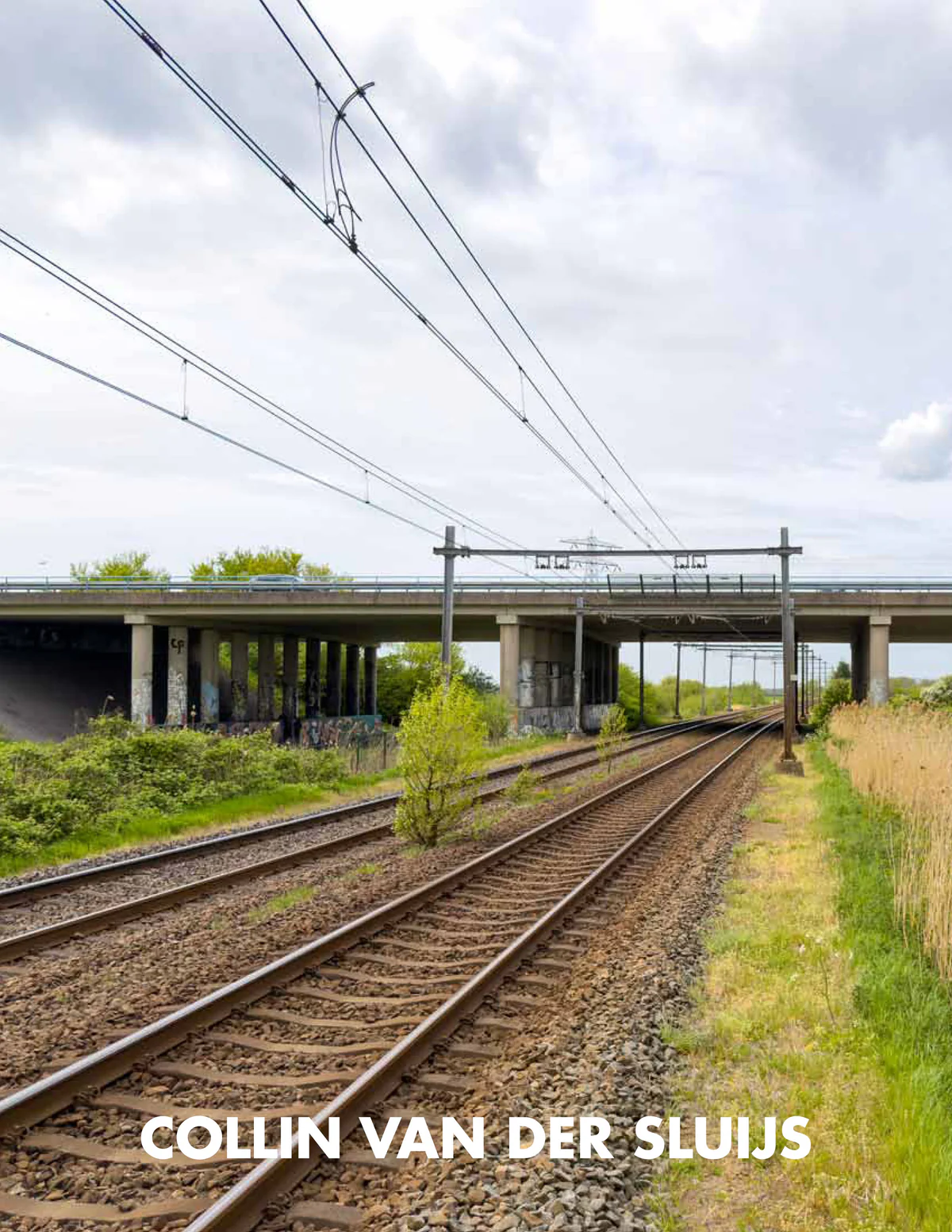
WanDERLAND: 1991-2026 BY COLLIN VAN DER SLUIJS (2026)
Excerpted from Tenacious Little Monkey’s introduction: The urge to create exists within us all. It is a fundamental human imperative — a primordial force that cannot be stopped, resisted or contained.
Carl Jung argued that we do not possess creative powers, but rather we are possessed by them. “Every creative person is a duality or a synthesis of contradictory aptitudes. On the one side he is a human being with a personal life, while on the other side he is an impersonal, creative process,” the father of analytical psychology writes. “Art is a kind of innate drive that seizes a human being and makes him its instrument. The artist is not a person endowed with free will who seeks his own ends, but one who allows art to realize its purpose through him.”
Collin van der Sluijs lives these contradictions in full. The urge to create is a raw, gnawing hunger that rousts him from bed at 6:00 a.m. seven days a week, increasing in ferocity as he bicycles to the sanctuary of his studio workspace, located about 10 minutes away from the Maastricht, Netherlands home he shares with wife Sandra and their two daughters. Once Collin enters the studio and straps on his headphones, the urge takes over, and the work pours out of him — spontaneous acts of expression erupting from the subconscious self, visceral and alive like bursts of free jazz.
“When I wake up, I need to paint. I have to go to the studio each morning. There's no other option,” Collin says. “It’s something that comes from the depths of my heart. It has such deep roots that if I couldn't do it anymore, it would be the end.”
Wanderland: 1991-2026, Collin’s first career retrospective, commemorates a compulsively creative life still very much in progress. Its pages juxtapose his exploits as a painter, muralist and graffiti writer with the human moments that define him in his roles as husband, son, father and friend — a modern-day Dutch master’s 35-year odyssey across his homeland and across the universe, from concrete to canvas and back again.
The book’s title derives from Collin’s latest solo exhibition, his sixth to date with Chicago’s Vertical Gallery. “This year marks 10 years of doing solo shows in Chicago. That's something to celebrate,” he says. “I wanted to do a book because it just feels good to have something physical in your hand which you can hold, and not scroll or flip or trip or something. Also, I turned 46 this year, so 50 in four years. It's about time to do something like this.”
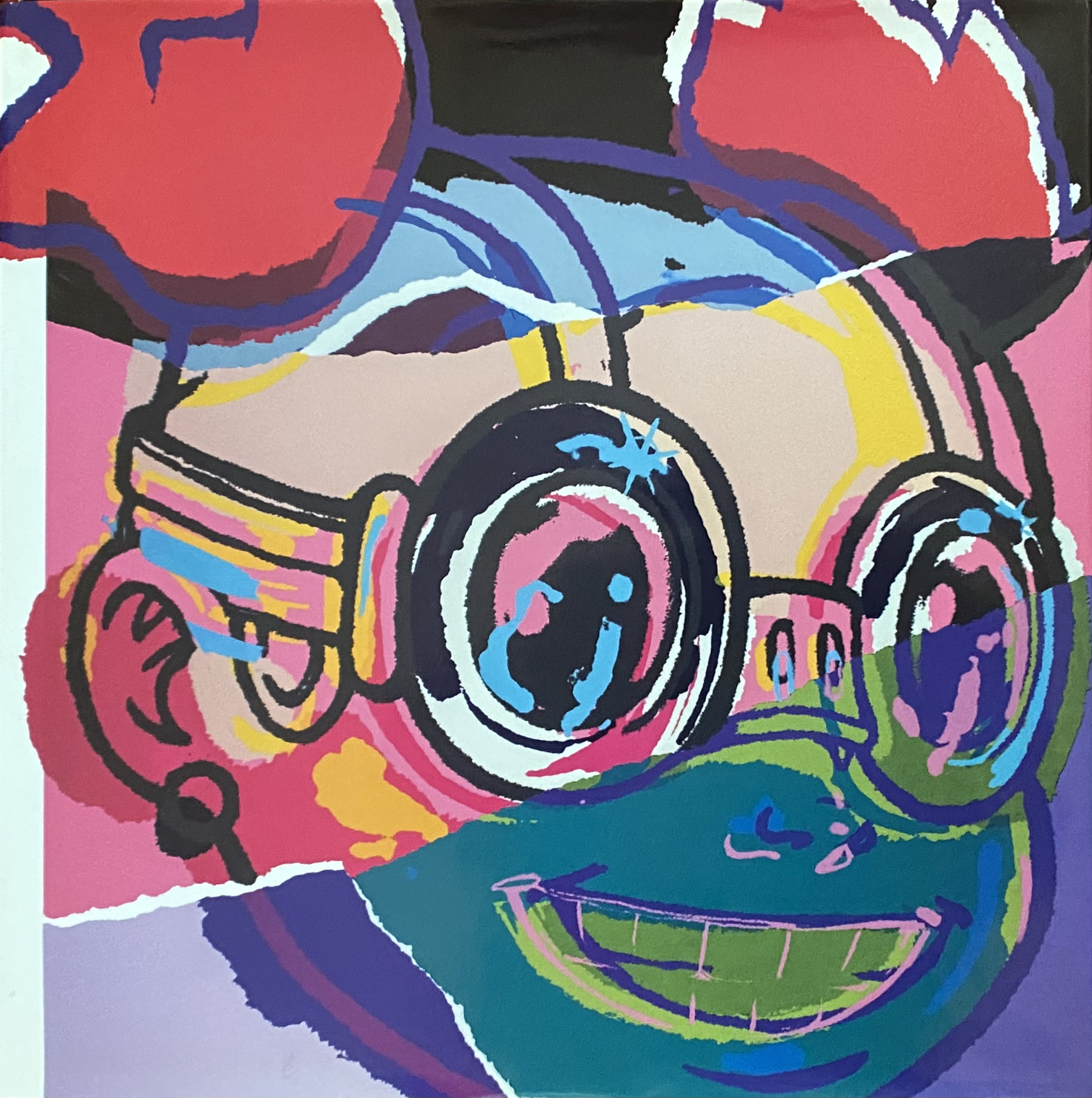
EDITIONS BY HEBRU BRANTLEY (2021)
Excerpted from Tenacious Little Monkey’s introduction: All the greatest fictional characters are flexible. Mickey Mouse, Bugs Bunny, Snoopy — these are pop culture icons not only because they are so brilliantly conceived, so sharply defined and so instantly recognizable, but also because they are infinitely durable and elastic, fitting seamlessly into any type of media milieu.
Take Superman. Whether proving himself faster than a speeding bullet in the pages of DC Comics, more powerful than a locomotive on the silver screen or able to leap tall buildings at a single bound in an Andy Warhol canvas, Superman’s essence remains intact: whatever the medium or whatever the narrative, he is an avatar of truth, justice and the American way. There is no plotline Superman cannot carry, no message he cannot deliver, and neither age nor familiarity have dimmed his potency. In fact, repeated exposure only strengthens a truly classic character’s bond with the audience; the more we see of them, the more we want to see.
Hebru Brantley’s characters possess the same elasticity, durability and crossover appeal as the legends that came before them. But Flyboy, Lil Mama and Phibby — the teen troika at the nexus of the artist’s ever-expanding fictional universe — also represent a new breed of hero: Fearless. Street-smart. World-weary yet hopeful. And unmistakably, unapologetically Black.
First rising to prominence through a series of attention-grabbing murals painted across Brantley’s native Chicago, Flyboy, Lil Mama and Phibby have over the last decade touched down everywhere from museums to music videos to Nevermore Park, the 6,000-square-foot interactive experience Brantley launched in his hometown in late 2019. While the characters are sturdy enough to address themes like racism, poverty and inequality, they look cute as hell splashed across the front of a preschooler-size hoodie, too. In short, they are both timely and timeless, poster children (in the figurative and literal senses) for a tumultuous period in history they are destined to outlive.
“I can use these characters to say whatever I want to say. It takes some of the weight or pressure off me as the creator in voicing my opinion,” Brantley explains. “It’s not dissimilar to a Sunday comic strip writer like [Peanuts creator] Charles Schulz, where they inject their being — their feelings, their anxieties, their experiences — into those strips. It comes through the mouths of babes. It comes through those characters. What I do is not dissimilar at all. It just happens in a different medium and a different sort of context.”
“BETTER HALF” BY JEROME TIUNAYAN (2026)
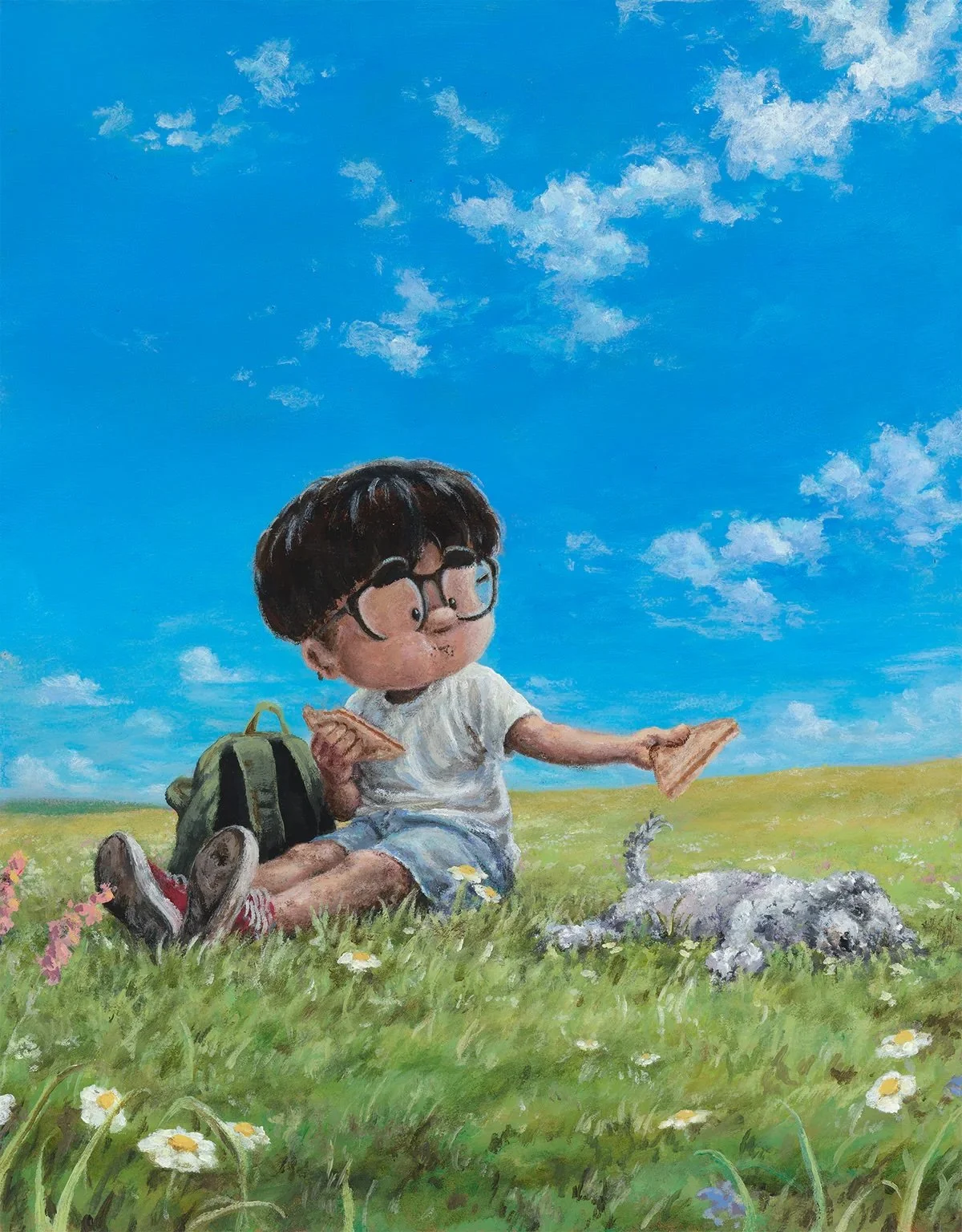
Excerpted from Tenacious Little Monkey’s online feature: Dogs make the best sidekicks, both in life and in art. Just ask Jerome Tiunayan.
Jerome’s sly, supple paintings, most recently on view inside Vertical Gallery’s booth at Aqua Art Miami 2025, showcase the fantastical exploits of his semi-autobiographical signature character and the boy’s canine comrade, a stand-in for the artist’s beloved mini goldendoodle Mochi. The dynamic duo’s misadventures continue with the Feb. 2 release of Jerome’s limited-edition print “Better Half,” the first installment in the new Vertical Collectors Club series.
“A character like mine needs a partner in crime,” Jerome says. “I think it's cool to come at a story from two different perspectives.”
Jerome and his now-wife Valerie adopted five-year-old Mochi (so named for Japan’s ubiquitous sweet rice cakes) prior to relocating to Chicago from their native New York City.
“Val’s a schoolteacher, and at that time, she spent her summers working in a pet shop,” Jerome recalls. “Mochi was ill when she arrived at the shop. She couldn’t be left unsupervised, so Val volunteered us to look after her for a few days. The idea was that the dog would eventually go back to the pet store — Val really wanted to keep her, but I didn't want to have any extra responsibilities. Then, on the second day that Mochi was there, I was drawing on the kitchen table, and she wormed her way in between my feet. She seemed to know exactly what to do to make sure that I would never get rid of her or give her up. It made me realize how selfish I was being, not only about her, but about Val. It grew from there... It felt nice to care for something outside of myself.”
Jerome’s affection for Mochi inevitably spilled into his fictional world. “I didn't really put much thought into it, beyond ‘It'd be cool if my character had a companion when I send him on adventures.’ I love Calvin and Hobbes [Bill Watterson’s classic comic strip about a precocious six-year-old and his stuffed tiger], and I'm sure that has something to do with it,” Jerome says. “There’s a balancing act to the work that features both characters. The kid’s an all-work kind of person, which reflects how I am in real life. The dog’s lighthearted, positive outlook is a reminder that it's okay to play every now and then.”
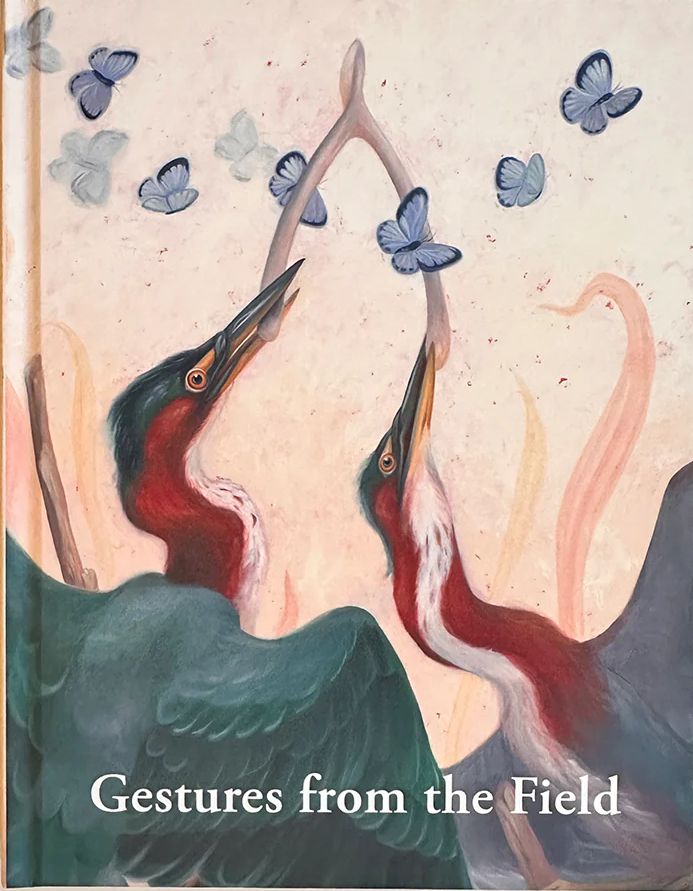
GESTURES FROM THE FIELD BY LAURA CATHERWOOD (2025)
Excerpted from Tenacious Little Monkey’s introduction: Field guides — illustrated manuals to help readers identify wildlife and other natural phenomena — are essential resources for understanding our physical world. Landmark publications like ornithologist Roger Tory Peterson’s 1934 classic A Field Guide to the Birds, the first installment in his long-running Peterson Field Guides series, redefined and reframed humankind’s relationship with our environment, employing detailed graphics, text entries, range maps and other taxonomic tools to illuminate the macroscopic diversity of life on Earth.
Laura Catherwood’s Gestures from the Field is a different kind of field guide — a topographic survey charting the terrain of human emotion and expression. Its mysterious, often mournful images depict our world the way Catherwood experiences it: from the inside out.
“The purpose of my work is to soothe, and to help people feel soothed,” the artist says. “In a way, I'm trying to make diagrams of feelings using nature, and I'm not shy about getting a little odd and surreal to achieve that purpose. Not all my paintings are about feeling good — they can be kind of sad. But my hope in sharing this inner world is that if you feel a connection, you feel comforted.”
Fauna, flora and the fantastic converge on virtually every page of Gestures from the Field, which traces Catherwood’s professional path backwards in time from her elegiac contributions to the September 2025 group show The Scenic Route, presented by Chicago’s Vertical Gallery, through to embryonic efforts from 2019. The book punctuates the first chapter of Catherwood’s career: in the wake of its release, she and her husband Bryan will relocate from her native Windy City to upstate New York.
“My work has always revolved around the Midwest, and its prairies, ponds and woods. Now I'm about to live somewhere else,” Catherwood says. “This book encapsulates my life in Chicago — the environment that I grew up in and the work that it inspired, which brought me to the threshold I’m on today.”
WE FROM THE HEAVENS BY TROY LEE (2025)
Excerpted from Tenacious Little Monkey’s press release: Vertical Gallery is very proud to present We From the Heavens, a solo showcase for Chicago-born, Los Angeles-based painter and illustrator Troy Lee.
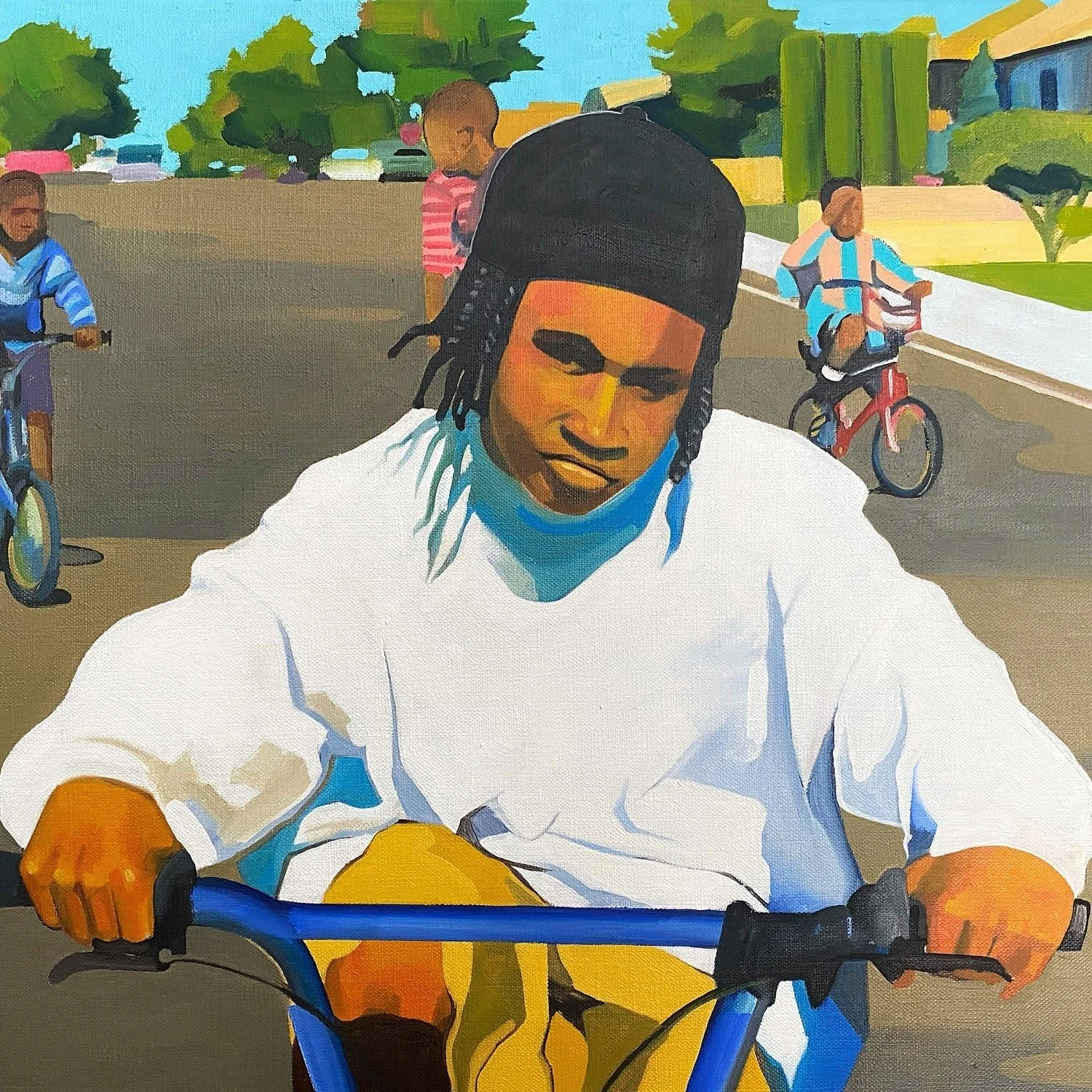
We From the Heavens, which runs March 7-29 at Vertical’s flagship West Town location, heralds a daring new chapter in Lee’s career and creative evolution, shifting the artist’s emphasis from feminine sexuality to masculine vulnerability. The exhibit’s soul-baring paintings and sketches aggressively interrogate the perceptions and realities confronting Black men in contemporary America — how they’re seen in the media, and how they see themselves in the mirror.
“My overall thing with this show is that I want to restore innocence to the Black body,” says Lee, who recently shed his longtime creative alias Troy Scat. “Most of my past work is centered around the celebration of women, but for this show, I decided to stir up conversations about men loving themselves — what's toxic masculinity, what's healthy masculinity, and what we can do to change these things.”
We From the Heavens embraces Black males of all ages, depicting some of them with wings; halo-like circles are another recurring motif. Many of the pieces draw inspiration from subtle but significant moments nestled deep within Lee’s favorite movies, television series, music videos and viral clips, a smorgasbord of sources stretching from the high school basketball dramedy Sunset Park to the bonkers science fiction saga The Fifth Element.
“The characters I’m referencing often are seen as villains in their original context. But I'm taking them out of that context, and magnifying the poetry of moments a lot of people may have missed,” Lee explains. “Take [the 2012 found footage-style drama] Snow on tha Bluff. The protagonist is a drug dealer. A lot of people see him as a bad guy. But there is a scene where he plays with his kid, and ultimately, that kid is who he's doing all of this other stuff for. I wanted to highlight that, because it's something that resonated with me.”
We From the Heavens follows a period of intense self-evaluation, guided in part by Lee’s immersion in the writings of theorist, educator and social critic bell hooks. “I recognized that I didn't show as much appreciation for myself as I claim to with women,” he says. “I think when it comes to fully appreciating anyone else, it starts with the self. I've learned to give myself some grace.”
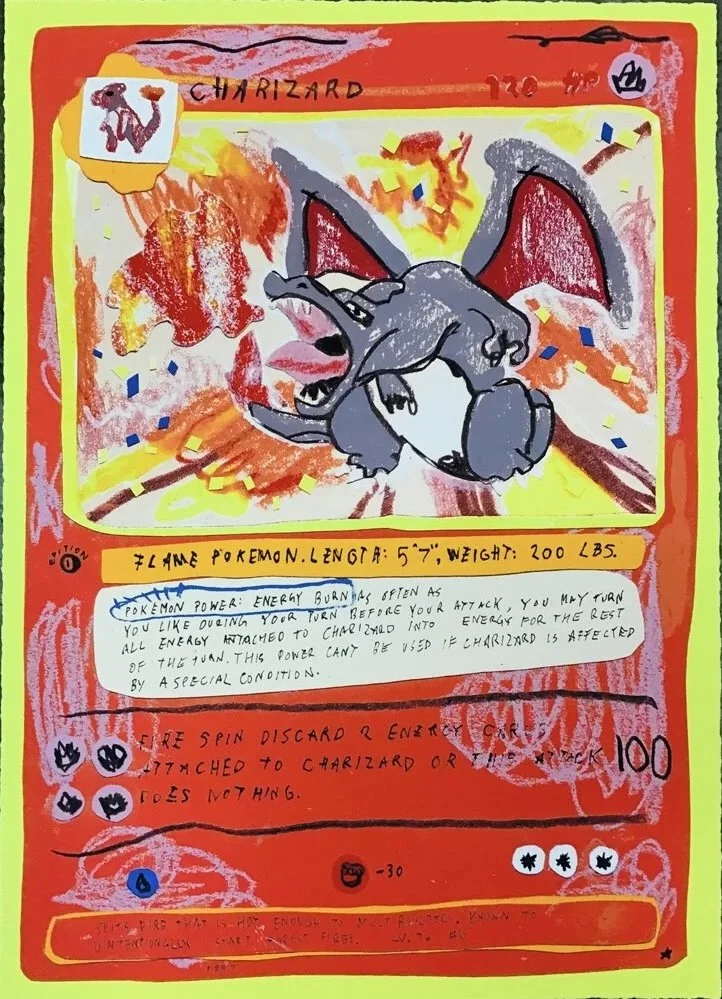
“1999 (CHARIZARD)” BY DAVID HEO (2026)
Excerpted from Tenacious Little Monkey’s case study: The art of David Heo erupts from the convergence of memory, myth and metamorphosis. His idiosyncratic, emotionally charged mixed-media assemblages — constructed from materials like crayon, colored pencil, oil stick, acrylic spray andpaper cutouts — recontextualize traditions and tropes from across Western art history and Korean folklore, capturing the visceral intensity of modern life and interrogating Heo’s place within it.
“With collage, there’s a poetic transference that happens for me when combining all the cut sheets of painted paper. It becomes a process of literal stacking, filled with gestures and memories. All that mixed materiality and their individual textures can be in reference to how densely layered my identity is,” says the Korean-American artist, who was raised in rural Georgia and now resides in Chicago.
POP!NK Editions first worked with Heo on a limited-edition screenprint for Smoke and Honey, his March 2020 solo exhibition at Chicago’s Vertical Gallery. “We’re big fans of David's work,” says POP!NK’s Curtis William Readel. “What attracted me was not only the imagery and the approach, but also the challenge of translating each of the different types of media through our process.”
When media and entertainment brand Complex Networks invited POP!NK to participate in the 2020 installment of its annual ComplexCon youth culture festival, Readel and fellow co-founders Zach Schrey and Steve Seeley approached Heo to create an exclusive print for release during the event. Heo pitched a project based on a recent collage celebrating Pokémon, the massively popular multimedia franchise created by Japanese videogame designer Satoshi Tajiri.
“During the COVID lockdown, David had gotten interested in Pokémon trading cards and collectibles, and he came in with that collector knowledge,” Readel explains. “He said ‘We have to do [the dragon-like character] Charizard — everybody's gonna go crazy.’ David's ‘1999 (Charizard)’ print sold out immediately, which started the process of doing three more Pokémon prints with him over the next two years.”