Everything ends badly. Otherwise it wouldn't end.
For more than a decade, artists leveraged Instagram to showcase their work and connect directly with collectors and gallery owners from all over the world. But the relationship has grown increasingly fraught in recent years as Instagram’s corporate parent Meta prioritized advertising revenues, shifted the social media platform’s algorithms away from chronological and static image feeds to short-form video, and kneecapped organic reach for creators who refused to purchase ads to reach followers they already have.
Meta’s recent Commercial Terms update twisted the knife much deeper. The proposed framework, first reported in late October, claimed a broad license to automatically crawl, index, cache and scrape external websites and domains linked to user business portfolios. Following a fierce public backlash sparked by legal experts warning Meta’s revamped rules amounted to an off-platform data land grab, Meta quietly removed the explicit word "train" from the clause, and in early November, faced with a sudden courtroom injunction from European media groups and a structural investigation by the UK Competition and Markets Authority, the company was forced to officially postpone the rollout across the UK and Europe.
But this is a temporary stay of execution, not a retreat. While the legal battle pauses the timeline, independent creators remain clear-eyed that Meta’s underlying intent to stripmine off-platform data remains a core part of its long-term AI development strategy.
Some artists are now ditching Instagram altogether — deleting their posts, uncoupling their website links or shuttering their business pages entirely. Others are adopting a defensive posture: removing their website URLs from their IG bios and striking links to their online shops, downgrading their accounts from “business/professional” to “personal” (a move that offers more psychological comfort than actual protection) and posting only cropped, watermarked or low-resolution images of their work. Still others are nervously maintaining the status quo, weighing the effects of blowing up their social media presence so close to the holiday shopping season versus the long-term damage threatened by Meta’s data crawlers.
Regardless of which path an artist pursues, the underlying anxiety remains the same: If you unplug from the world’s premier visual discovery engine, how do you continue communicating with the collector audience, booking exhibitions and marketing your life’s work?
Breathe easy. Artists do not need Meta to build or maintain a sustainable career.
Contemporary art’s post-Instagram era belongs to owned media — digital channels that artists control lock, stock and barrel, blissfully free from corporate data harvesting and algorithmic extortion.
Here’s what you need to know to transition from an unpaid content creator subject to a tech oligarch’s whims to a self-sovereign publisher building a tiny media empire solely on your commercial terms.
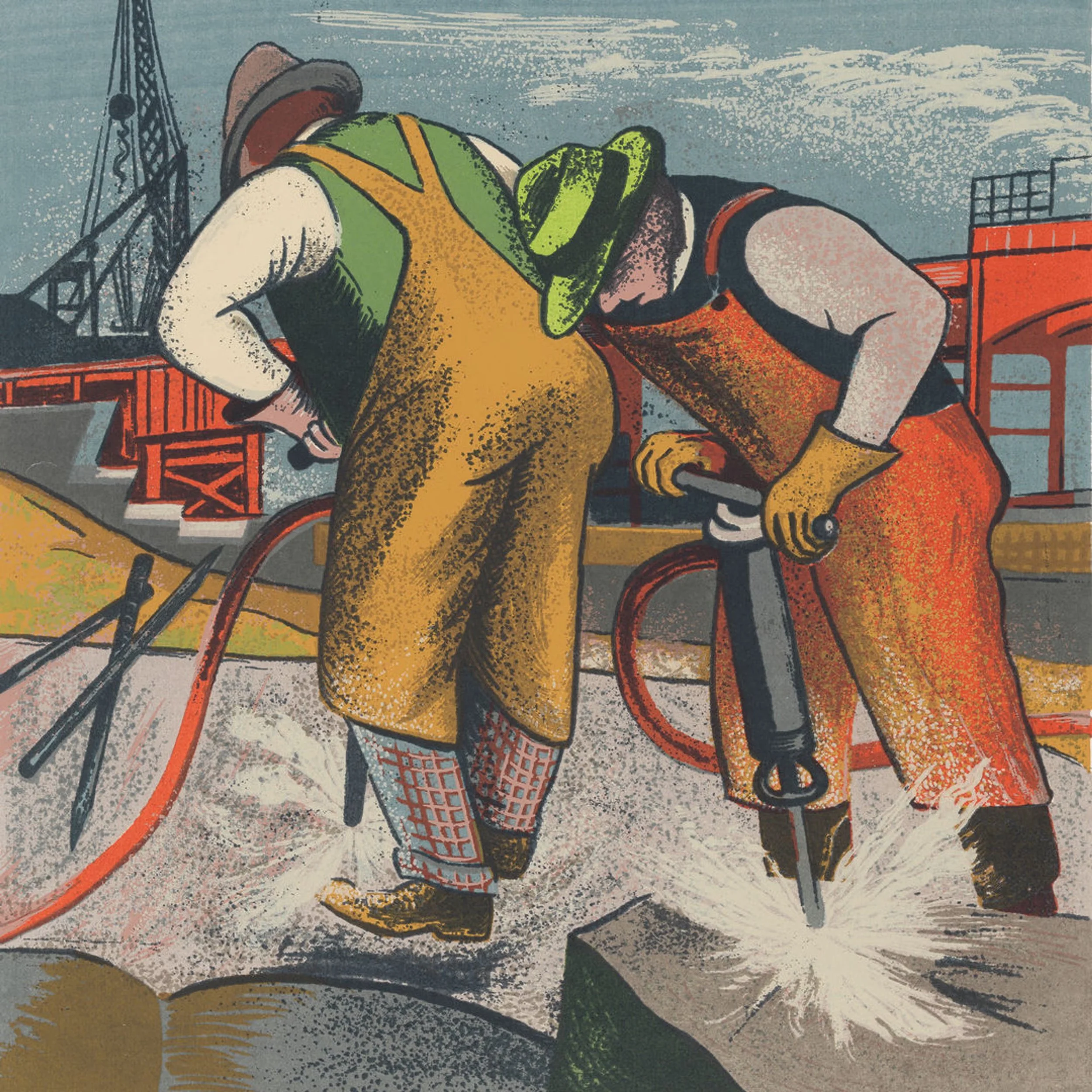
Rock Drillers (1939) by Harry Gottlieb. The Metropolitan Museum of Art, New York.
WHAT IS OWNED MEDIA, AND HOW DOES IT DIFFER FROM SOCIAL MEDIA?
The core distinction between owned media properties (websites, blogs and email newsletters) and social media platforms (Instagram, Cara and Bluesky) comes down to ownership versus rented space — a dynamic that shapes the economics of an artist's practice in five primary ways:
Control: Owned media gives you total freedom to design the user experience, customize the layout and choose exactly how to monetize your efforts. Instagram, on the other hand, requires you to follow its rigid layouts, formats and community guidelines.
Algorithmic volatility: Owned media reaches your audience directly — for example, an email delivered straight to inboxes. Instagram’s algorithm changes can instantly torpedo your organic reach and hide you from people who explicitly asked to see you.
Data access: Owned media grants you full ownership of your subscriber lists, customer data and pixel tracking data. Meta owns your Instagram user data, and if your IG account is banned or hacked, you lose your connection to your followers.
Cost: Owned media limits long-term costs to site hosting and software tools. Instagram is pay-to-play: Ad spending is the only way to ensure your content reaches a broader audience, or even your existing followers.
Audience discovery: Owned media depends heavily on search engine optimization, direct traffic and word of mouth to attract eyeballs. Built-in Instagram discovery tools like the Explore page, the Reels tab and hashtags make it easy for strangers to find you.
Owned media transforms algorithmic cannon fodder into media equity — evergreen, searchable business assets that funnel a highly targeted audience of actual collectors, clients and fans straight to your doorstep, driving traffic, building trust and protecting your intellectual property for years to come.
Consider the lifecycle of a process video or portfolio piece uploaded to Instagram today. The algorithm pushes it out to a fraction of your audience for roughly 48 hours: Because social media organic reach averages just 3.6 percent to 5.2 percent, fewer than one in 20 followers will see your handiwork before the algorithm leaves it for dead on Meta’s servers, where non-consensual AI models quietly feast on its carcass to train your digital replacements.
When you publish that exact same process story on your own website domain, the power dynamic completely flips. Instead of begging an algorithm for reach, you send a direct, unmediated link to a private subscriber list that you actually own, and because your website showcases high-quality, text-rich human storytelling, Google’s E-E-A-T (Experience, Expertise, Authoritativeness, and Trustworthiness) ranking system — explicitly designed to reward this kind of people-first, authentic content — makes certain search engines treat your efforts with the dignity you deserve.
But transitioning to owned media doesn’t mean abandoning Instagram — which, let us not forget, remains the world’s premier visual discovery engine whether you’re there or not.
It means stripping Meta of the power it wields over your professional and financial stability.
And that means exploiting Meta’s platform, instead of the other way around.
SWAPPING FOLLOWERS FOR TRUE FANS: HOW TO BEAT META AT ITS OWN GAME
Before we go any further, make no mistake: the moral and ethical compromises that professionals must make to remain on Instagram are not lost on Tenacious Little Monkey. Meta’s latest data-harvesting overreach cuts far deeper than existential business dread: it rubs our fucking faces in Silicon Valley’s bottomless contempt for human creativity. Staying on Instagram no longer feels like a strategic compromise — it feels like full-on, bending-the-knee complicity.
Immediate and total digital exile is a luxury few artists can afford, however. So how do you sleep at night posting your work to an app that feels increasingly hostile to your very existence?
By rewriting the rules of engagement. The exact same thing Meta is doing to you.
Owned media doesn’t ignore Instagram's reach: It weaponizes it. Instead of posting for clout, you’re mining Instagram for human attention, the platform’s single most valuable asset. A successful owned-media strategy treats Instagram strictly as a discovery engine — a digital billboard to capture attention — and then immediately funnels that person off the app and onto your email newsletter list, where Meta can no longer control or monetize the relationship.
Here’s how you do it.
Give the human eye a reason to stop scrolling, but hold back the full weight of your work. Post high-impact visual bait — extreme close-ups, raw sketches and heavily compressed detail — but withhold the complete narrative, the deep context and the pristine, high-resolution execution. From now on, if Instagram users want the full monty, they have to leave the app.
Shift your call to action from likes to inboxes. An email subscriber list unlocks your owned-media strategy. Email is the highest-converting sales channel for creatives (standard industry data shows that email marketing yields an average return of roughly $36 to $42 for every $1 spent), and its direct, unmediated communication with collectors is immune to algorithmic upheaval. Don’t ask people to "Leave a comment below" or "Save this post” — tell your audience “Get first-look access to my newest work when you join my private collector list via the link in my bio” and watch the money roll in. Hiscox, the premier statistical authority on how art is bought and sold online, reports that 57 percent of collectors prefer buying through self-hosted websites and newsletters, dwarfing the 21 percent who purchase via social platforms.
Stop using generic multi-link landing pages that disperse your audience in all different directions. Your bio link should highlight one primary destination: A distraction-free, high-converting landing page on your own website. Offer visitors a bargain they can’t refuse, like access to a high-value piece of exclusive human storytelling (a studio tour or creative manifesto) in exchange for their email address.
Convert casual social interactions into direct relationships you own. When a collector reaches out about a piece, don't leave them wandering around in Meta's comment sections or looking for an external link tree. Guide them directly to a conversational handoff: share a private link to your website's studio log or a dedicated newsletter sign-up.
Don’t be surprised if your Instagram metrics suffer a massive hit the moment you begin executing this strategy. Meta finances its ivory back scratchers by trapping human eyes inside its walled garden, and the minute you start urging followers to leave the app or steer them toward an external link in your bio, Zuckerberg’s automated gestapo will descend: Your view counts will nosedive, your comments will turn to crickets and your vanity engagement will shrivel up.
Do not panic. This algorithmic plunge is not a sign of failure — it is the empirical proof that your owned-media strategy is working. Meta is throttling your reach, because it is utterly terrified of losing users to a better mousetrap. What you’re shedding is low-intent digital noise; what you’re gaining is real, unthrottled email addresses from dedicated human collectors who respect you and the work you create. That’s a victory every single time.
START BUILDING YOUR OWNED-MEDIA EMPIRE TODAY
Becoming a mogul is easy. You just need to sit down and complete a straightforward, one-time configuration across three specific digital platforms: your web host, your email marketing service and your Instagram settings. Here’s a step-by-step checklist.
Step 1: Secure the Domain and Web Host
If you already have a professional website (Squarespace, Wix, Shopify or WordPress), you are halfway there. If you don't, you must:
Go to a registrar (like Namecheap, Squarespace or GoDaddy) and purchase your personalized version of the generic artistname.com.
Choose a platform and sign up for a basic hosting plan. If you just want a simple gallery and landing page, Squarespace or hosting directly through an email provider (like Substack or Ghost) is the easiest route.
Step 2: Set Up the Email Service Provider (ESP)
You need a dedicated platform to collect subscriber addresses and blast out newsletters. You cannot run a professional collector list out of a personal Gmail account; your messages will immediately get flagged as spam.
Sign up for an artist-friendly service like Substack, Ghost or Mailchimp. Most of these platforms are completely free for your first 1,000 subscribers.
To make sure your newsletters actually land in your collectors' inboxes and not Promotions or Spam folders, you need to prove you officially own your website domain. Your email provider will give you three short strings of text (often called DNS, TXT or CNAME records). You simply copy those text strings, log into your domain registrar (where you bought your website) and paste them into the settings panel. Every major email provider has a simple, two-minute setup wizard to guide you through this copy-paste process.
Keep it lightweight. An email packed with 15 giant, uncompressed, high-resolution images will cause email providers to block the message entirely. Instead, feature one beautiful, high-impact image that serves as visual bait, and include a clear button linking back to a dedicated gallery page on your website for the rest.
Step 3: Build the Landing Page
This is the destination for your Instagram bio link.
Create a clean page with a simple URL, like /subscribe or /join.
Avoid aggressive, stripped-down direct-response layouts. Instead, use a minimalist header with your logo and a subtle "View Gallery" link to respect fine art collectors while maintaining focus on the sign-up.
Embed the form from your email provider in the center of the page.
State the value clearly in a short paragraph above the form, offering exclusive perks like priority collection drops and behind-the-scenes stories.
Step 4: Configure the Instagram Bio Link
Remove generic aggregators and third-party link trees to protect data and focus visitor attention.
Create a dedicated page on your website (e.g., /links) featuring an email subscription form at the top.
Optimize the bio link with your custom, self-hosted hub page prioritizing email capture.
Open Instagram, go to "Edit Profile" and "Links," then paste your new self-hosted hub URL.
Meta’s policy change isn't a crisis. It’s a boundary line — the catalyst the art world needed to reclaim its independence, protect its creators and speak directly to the people who matter most.
Moving beyond Instagram is an advancement toward a more sustainable, dignified and profitable art career. Tenacious Little Monkey can help. I partner with artists, galleries and arts-focused small businesses to write the deep-dive artist profiles and text-rich exhibition previews that make owned-media ecosystems flourish. You handle the one-time digital infrastructure, and I’ll handle the rest.
You’ve spent years protecting your creative vision. Now it's time to protect your business model, too.
Let's stop building tech oligarchs' empires… and start building yours.
